September 21, 2026
From chat operator to hybrid AI model
Your customer service team is handling growing conversation volumes, your Chat Operators are overwhelmed during peak periods, and coverage outside business hours remains a blind spot. Shifting to a hybrid model (AI for routine requests, humans for complex cases) is today the most effective way to maintain a high service level without proportionally increasing headcount. Here’s how to do it in practice.
The reality: the 100% human model is reaching its limits
In a large organization, a Chat Operator position carries an average annual gross cost of €28,000 to €35,000 depending on experience, plus employer contributions, training costs, management overhead, and replacement costs during absences. For a team of 5 operators, total cost often exceeds €200,000 per year, and coverage is still limited to working hours.
Yet customer expectations have shifted dramatically. 90% of customers now expect an immediate response (within 10 minutes) regardless of when they reach out. An expectation the purely human model cannot meet in an economically sustainable way.
That’s not a reason to eliminate Chat Operators; it’s a reason to redefine their role.
The hybrid model: what AI handles, what humans keep
The key to a successful transition is clearly defining each party’s scope. Industry studies show that 60 to 80% of customer service conversations are recurring and predictable requests: order tracking, opening hours, return policy, product availability, standard quote requests, password resets. These are ideal for an AI chatbot.
The remaining 20 to 40% (complex disputes, emotionally charged situations, out-of-procedure requests, negotiations) require human judgment and adaptability that AI cannot yet effectively replace.
The optimal hybrid model:
- The AI chatbot handles routine requests 24/7, with no waiting time
- Intelligent handoff automatically escalates to a human operator when the request falls outside the chatbot’s scope or when the customer explicitly asks for it
- The human operator focuses exclusively on high-value cases, sensitive situations, and customer retention
The result: your Chat Operators handle lower volume, but every conversation they manage is a genuine opportunity to create value; not a repetitive question that could have been automated.
The 5 steps to a successful transition
Step 1: Audit your current conversations
Before deploying anything, analyze your conversation logs from the past 3 months. Identify the most frequent request types, their average handling time, and the requests generating the most dissatisfaction. This analysis defines your chatbot’s scope and gives you the baseline to measure its impact after deployment.
Step 2: Define the priority scenarios to automate
Don’t try to automate everything at once. Identify the 3 to 5 most frequent and straightforward request types, and build your first flows around them. A well-calibrated flow on a frequent request generates more value than ten approximate flows covering rare cases.
Step 3: Configure the handoff to human agents
This is the most critical step for customer experience quality. Define precisely the conditions under which the chatbot transfers the conversation to an operator: unrecognized request type, expression of dissatisfaction, explicit customer request, or after a set number of exchanges without resolution. The handoff must be seamless; the operator receives the full conversation context before taking over, without asking the customer to repeat themselves.
Step 4: Train your teams on this new model
Resistance to change is the main obstacle in large organizations. Your Chat Operators need to understand that the goal is not to replace them, but to free them from low-value tasks so they can focus on what they do best: building relationships, solving complex problems, retaining customers. This communication is as important as the technical deployment.
Step 5: Measure and continuously adjust
Key metrics to track after deployment: chatbot autonomous resolution rate (without handoff), CSAT on chatbot-handled vs. human-handled conversations, average handling time, and volume of transferred conversations. This data lets you continuously refine your chatbot’s flows and optimize the line between automated and human.
The concrete ROI of a hybrid model
A concrete example. A team of 4 Chat Operators handling 2,000 conversations per month, of which 65% are recurring automatable requests:
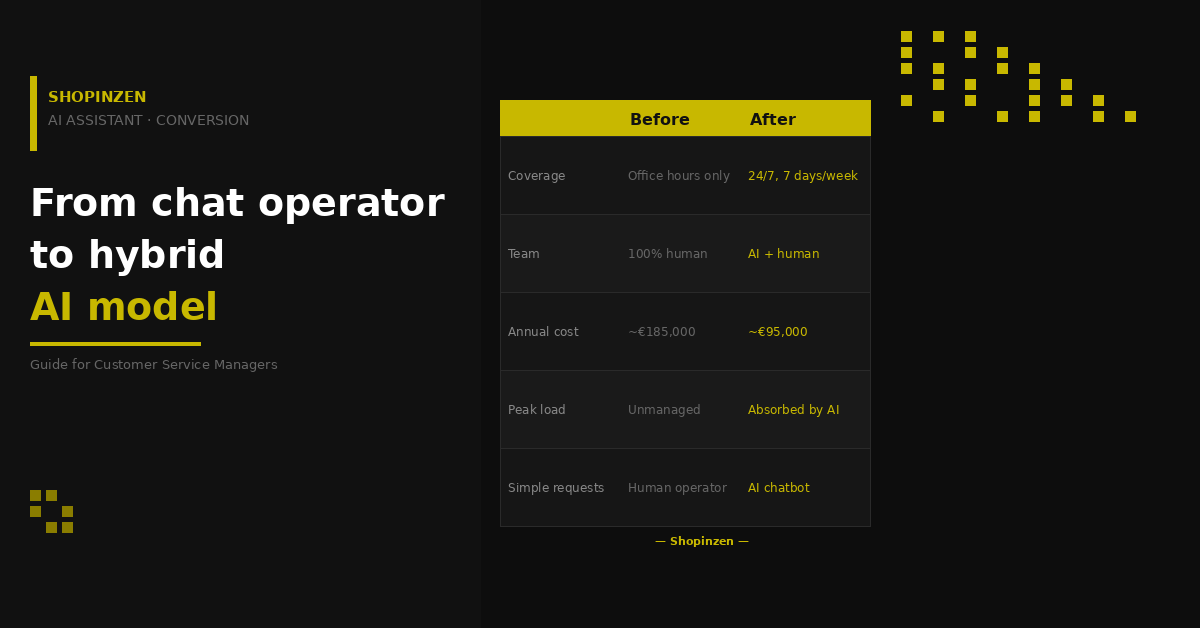
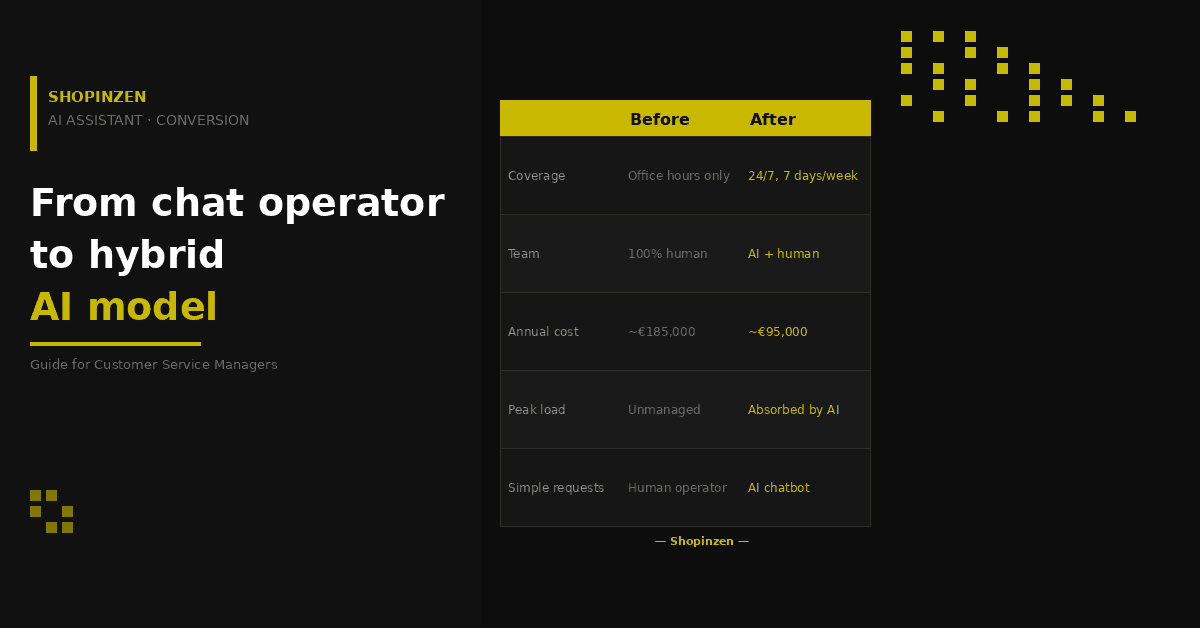
- Before: 4 operators × €32,000 gross/year = €128,000 + employer contributions ≈ €185,000 total annual cost
- After hybrid transition: the chatbot autonomously handles 1,300 conversations/month. The remaining 700 (complex) require 2 operators instead of 4. Saving: approximately €85,000 to €90,000 per year, while maintaining 24/7 coverage
Add to this the indirect gains: reduced response times, improved CSAT, and the ability to absorb volume peaks without emergency hiring.
Why Shopinzen is suited to enterprise customer service teams
Shopinzen was designed to be deployed without depending on IT teams: Customer Service Managers can configure and adjust flows themselves, from an intuitive visual interface, with no technical skills required.
For a large organization, the key differentiators are:
- Configurable handoff to human agents: define escalation conditions precisely from the dashboard
- Full conversation context passed to the operator: the agent receives the complete history before taking over
- 24/7 availability: permanent coverage with no on-call surcharge
- Multilingual: for companies with an international customer base
- France-hosted, GDPR-compliant: a prerequisite for companies subject to strict regulatory requirements
- Real-time analytics: to monitor hybrid model performance and justify ROI internally
Conclusion
Fully replacing a Chat Operator with a chatbot is a poorly framed goal — and often counterproductive. Redefining your operators’ role through a well-structured hybrid model is the real opportunity: less volume handled mechanically, more value created in every human interaction, and finally continuous customer coverage.
Large organizations that have made this shift report significant gains in operational costs, CSAT, and their ability to absorb peak load without compromising the service quality their customers expect.
Shopinzen lets you deploy this hybrid model quickly, without technical dependency, with free access to get started. Discover it at shopinzen.com.
This article is for informational purposes. Salary data cited comes from recognized sources (Glassdoor, Jooble, Page Personnel) and may vary by sector and region.