8/3/2026
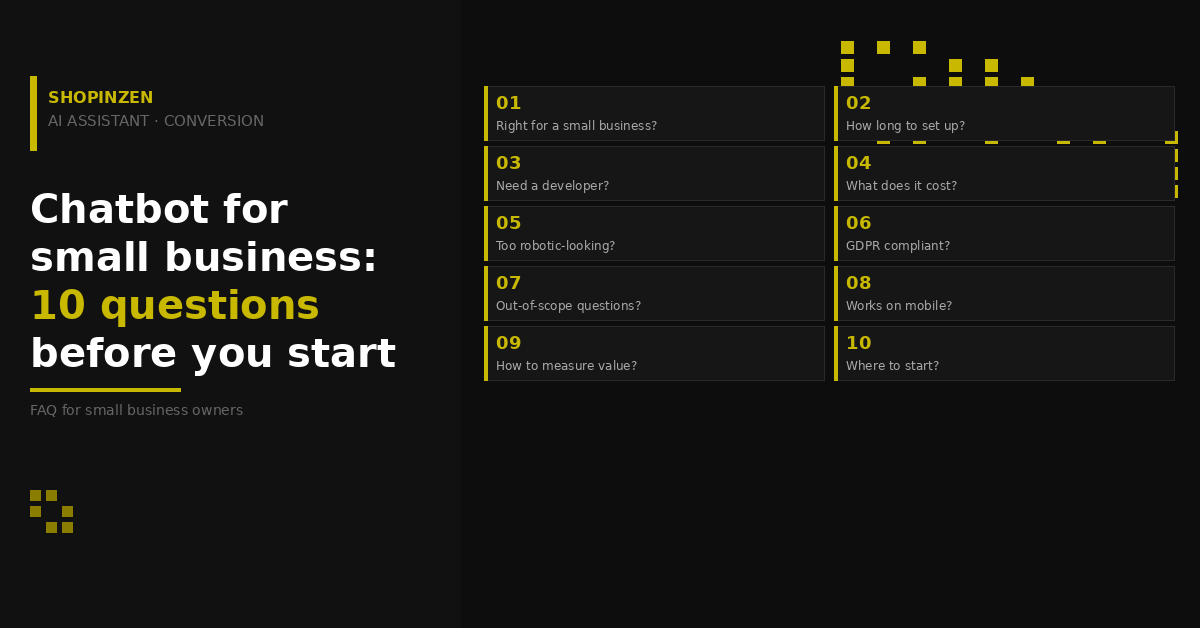
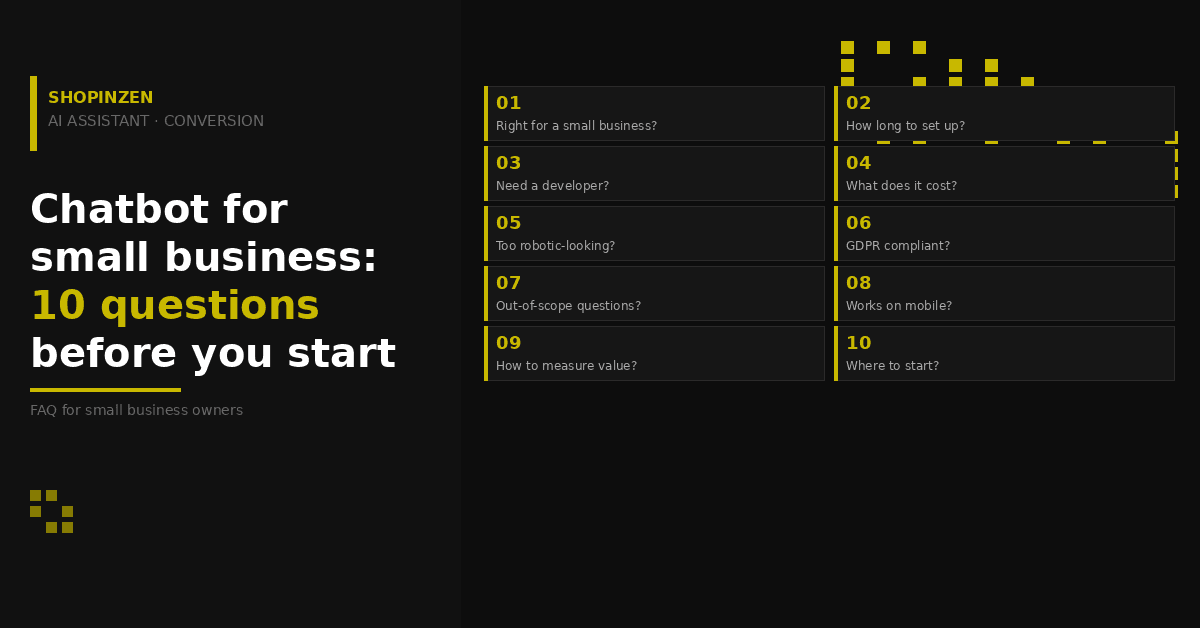
Chatbot for small business: 10 questions before you start
You run a small or medium-sized business and the idea of adding a chatbot to your website has caught your attention — but you still have questions. Is it right for my type of business? How long does it take to set up? Does it comply with GDPR? Here are the 10 questions small business owners ask most often before taking the plunge, with concrete answers and no technical jargon.
1. Is a chatbot really suited to a small business?
Yes — and small businesses are often the ones that get the most value from it. A large company has dedicated customer service and communications teams. A small business relies on a limited number of people managing everything at once. A well-configured chatbot absorbs repetitive questions, captures leads outside business hours, and frees up time for what really matters: your clients, your projects, your growth.
2. How long does it take to set up?
Less than an hour for a first deployment. With a solution like Shopinzen, account creation takes under 2 minutes, installation on your site (via a simple copy-paste) under 10 minutes, and configuring a first conversation flow between 20 and 40 minutes depending on how much you customize. No project meeting, no external contractor needed — you can do it yourself, or hand it off to any team member comfortable with a computer.
3. Does it require a developer or an IT department?
No. Modern chatbot solutions, including Shopinzen, are fully no-code: they install without touching your site’s source code and are configured through an intuitive visual interface. If you can use a word processor or a professional messaging app, you can use Shopinzen.
4. How much does it cost for a small business?
Shopinzen offers a freemium model: you start for free, with no credit card and no commitment. This lets you test the real impact on your business before considering a paid plan. For most small businesses with a brochure website and a moderate contact volume, the free plan is enough to validate the tool’s value — and the paid plans remain accessible, without the enterprise pricing that characterizes some solutions on the market.
5. Will the chatbot make my business look too « robotic »?
Not if you configure it correctly. A Shopinzen chatbot is fully customizable: tone, vocabulary, assistant name, colors, opening messages. You can give it your company’s voice — warm, professional, or playful depending on your sector — so visitors feel like they’re interacting with your brand, not a generic bot. This is exactly what more and more small businesses do, naming their assistant after a real or fictional team member.
6. Does it comply with GDPR?
Yes, as long as you choose the right solution. Shopinzen hosts data in France, does not sell it to third parties, and lets you configure retention periods from your dashboard. The assistant clearly identifies itself as an automated program, in line with the European AI Act in force since 2024. For a small business without a dedicated legal team, choosing a tool built for the European market is the simplest way to stay compliant without spending hours on it.
7. What happens if a visitor asks something the chatbot can’t answer?
It’s a planned and managed situation. A well-configured chatbot never leaves a visitor stuck: if the question falls outside the flow’s scope, it offers to redirect to a contact form, an email, or a phone number. You can also enable a handoff to a human agent for cases that require direct involvement. The goal isn’t to automate everything — it’s to automate what can be automated, and intelligently handle the rest.
8. Does the chatbot work on mobile?
Yes. Shopinzen is responsive by design: the widget automatically adapts to all screen sizes, whether desktop, tablet, or smartphone. This is essential — over 60% of web traffic now comes from mobile, and a poor smartphone experience means missed opportunities.
9. How do I know if the chatbot is actually delivering value?
By tracking a few simple metrics available in your Shopinzen dashboard: number of conversations initiated, flow completion rate, and the number of leads or contact requests generated via the chatbot. Compare these figures with your average conversion rate before deployment — the difference is generally visible within the first few weeks. Businesses deploying Shopinzen report an average of +35% conversion rate and -40% bounce rate.
10. Where do I start, concretely?
Start by identifying the page on your site where you lose the most visitors — often the contact page, the services page, or the homepage. Deploy your chatbot on that page only, with a simple flow: a welcome message, two or three qualifying questions, and an invitation to leave contact details or ask a question. Measure the impact over two to four weeks, adjust, then gradually expand. The most common mistake is trying to cover everything from day one — a targeted, well-calibrated flow always generates better results.
Conclusion
The questions small business owners ask before installing a chatbot are legitimate — but the answers are almost always reassuring. A modern tool like Shopinzen installs quickly, complies with GDPR, requires no technical skills, and can be tested for free. The only real risk is waiting too long while your visitors leave without getting in touch.
Try Shopinzen today, at shopinzen.com.
This article is for informational purposes. Statistics cited come from recognized industry sources and are subject to change.