7/24/2026
AI Chatbot & GDPR: what you need to know
You’re considering adding a chatbot to your website, but GDPR compliance concerns are holding you back? You’re right to ask the question — and wrong to let it stop you. Here’s what you actually need to know as a small business, without legal jargon, to deploy a conversational assistant with complete peace of mind.
Why GDPR applies to chatbots
A chatbot interacts with your visitors, answers their questions, and in many cases collects information: a first name, an email address, a project description, a location. As soon as a piece of data can directly or indirectly identify a person, GDPR applies — and that includes chatbot conversations.
The French data protection authority (CNIL) is explicit on this point: data exchanged in a conversation with an automated assistant constitutes personal data under the regulation, even if your chatbot doesn’t explicitly ask for a name or email. The simple fact that a visitor describes their problem or situation can be enough to make the data personal.
Good news: this doesn’t mean chatbots are prohibited or inherently risky. It simply means they need to be configured in line with a few clear rules — rules that are entirely accessible to any business, regardless of size.
The 5 concrete obligations to meet
1. Clearly identify the chatbot as an automated program
The European AI Act (EU Regulation 2024/1689), in force since 2024, reinforces an obligation that already existed in the spirit of GDPR: any user interacting with an AI system must be informed that they are not speaking with a human. In practice, your chatbot must present itself clearly as an automated assistant, not as a human advisor. A name like « Virtual Assistant » accompanied by an explicit mention is enough to satisfy this requirement.
2. Inform users about data collection
As soon as your chatbot collects personal data — even just an email to send a quote — you must inform the user about that collection, its purpose, and how long the data will be kept. This information can appear in an introductory message (« By continuing this conversation, you agree that your data will be processed in accordance with our privacy policy ») or in a notice accessible from the chat window.
3. Define and respect a data retention period
You cannot keep chatbot conversations and collected data indefinitely. The CNIL recommends defining a retention period proportionate to the purpose: for a lead generation chatbot, a period of 3 years from the last contact is generally considered reasonable. Beyond that, data must be deleted or anonymized.
4. Ensure data is hosted within the European Union
This is where many US-based chatbot solutions create problems. When personal data from European citizens is transferred to servers located outside the EU — particularly in the United States — additional obligations apply (standard contractual clauses, adequate safeguards), and the risk of non-compliance rises significantly. In 2025, the CNIL issued 83 sanctions totalling nearly €487 million, partly linked to inadequately framed data transfers outside the EU.
Choosing a chatbot hosted in France or within the European Union considerably simplifies your compliance on this point.
5. Enable users to exercise their data rights
Any user who has interacted with your chatbot has rights over their data: the right to access, rectify, erase (« right to be forgotten »), and object. Your privacy policy must state how to exercise these rights, and you must be able to respond within one month.
The real risks for a small business that ignores these rules
GDPR is not a regulation for large companies only. Sanctions apply to all businesses and can reach €20 million or 4% of global revenue — although in practice, amounts imposed on small businesses are proportionally much lower.
The most immediate risk for a small business isn’t the fine — it’s a formal notice: the CNIL can require you to stop using your chatbot or substantially change its configuration, interrupting your business and damaging your reputation. In 2025, the CNIL announced reinforced controls on AI usage, with the first formal notices linked to AI agents expected during the year.
The good news: for a small business using a standard lead generation or customer support chatbot, compliance is straightforward as long as you choose the right tool.
What Shopinzen includes natively for your compliance
Shopinzen was designed from the ground up to meet French and European market requirements. In practice:
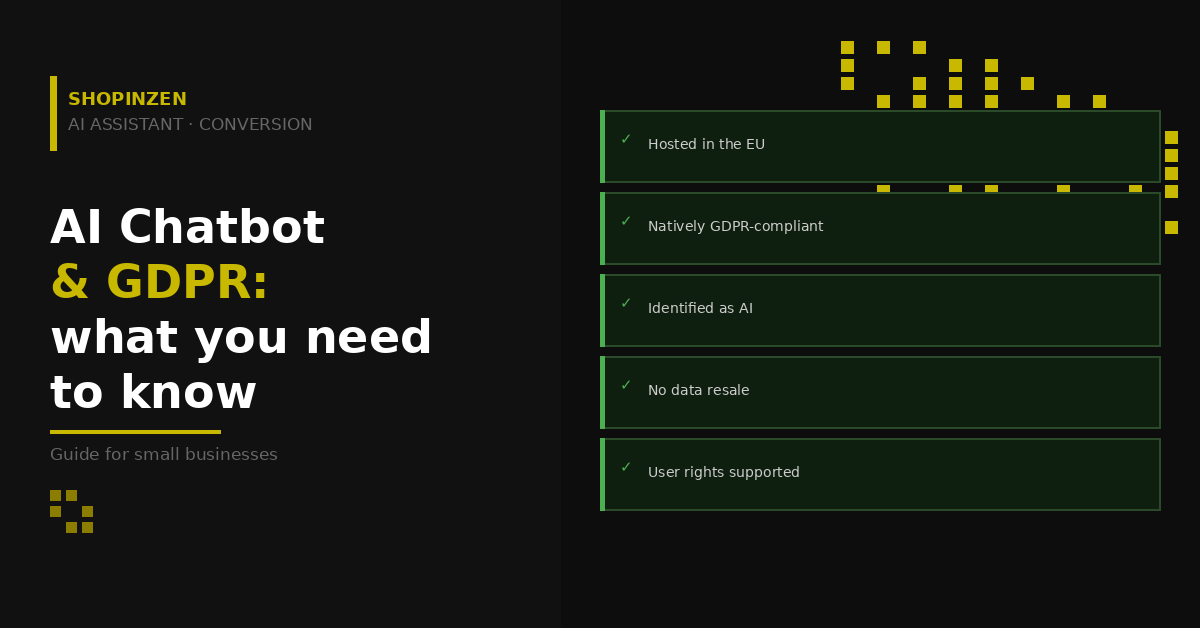
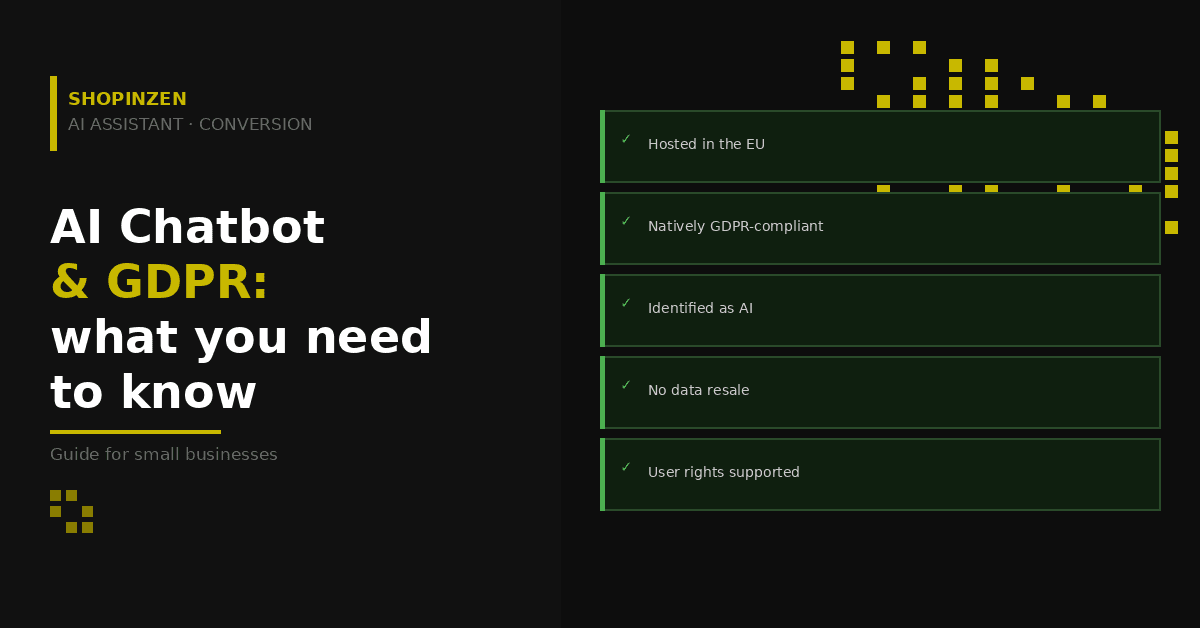
- Secure hosting in France: your data and your visitors’ data stay on servers located within the European Union, with no transfer to third countries
- Automatic identification as an AI assistant: the chatbot presents itself clearly as an automated program, in line with AI Act requirements
- Configurable data retention: retention settings are adjustable from the dashboard, with no technical intervention required
- Linkable privacy policy: a link to your privacy policy can be embedded directly in the chat window
- No data resale: data collected via Shopinzen is not used for advertising purposes or shared with third parties
For a small business without a dedicated legal team, choosing a tool already configured for GDPR compliance is the simplest and safest way to deploy a chatbot without regulatory risk.
GDPR checklist for your chatbot
Before going live with your chatbot, verify these points:
- ✅ The chatbot explicitly presents itself as an automated assistant
- ✅ A data collection notice is displayed at the start of the conversation
- ✅ Your privacy policy mentions the chatbot and the data it collects
- ✅ A data retention period is defined and enforced
- ✅ Data is hosted within the European Union
- ✅ A contact channel is available for users to exercise their access, rectification, and erasure rights
Conclusion
GDPR is not an obstacle to deploying a chatbot — it’s a framework that protects your customers and your business. For a small business, compliance largely comes down to choosing the right tool (EU-hosted, transparent about data collection) and updating your privacy policy. Steps that are entirely manageable, with no lawyer or developer required.
Shopinzen is built to be GDPR-compliant from installation, with secure hosting in France. Try it free, no credit card required, at shopinzen.com.
This article is for informational purposes only and does not constitute legal advice. For questions specific to your situation, we recommend consulting a legal professional or contacting the CNIL (cnil.fr).